Peter Andrew Danzig
Case StudyPeter Andrew Danzig is a Philadelphia psychotherapist, researcher, international public speaker and culture strategist. That means two very different visitors: someone looking for a therapist, and an organization looking for a speaker. I built a six-page site that gives each of them a clear path of their own, in a palette sampled from Peter's own photographs. It scores 100 in all four PageSpeed categories on desktop.
Visit PeterAndrewDanzig.com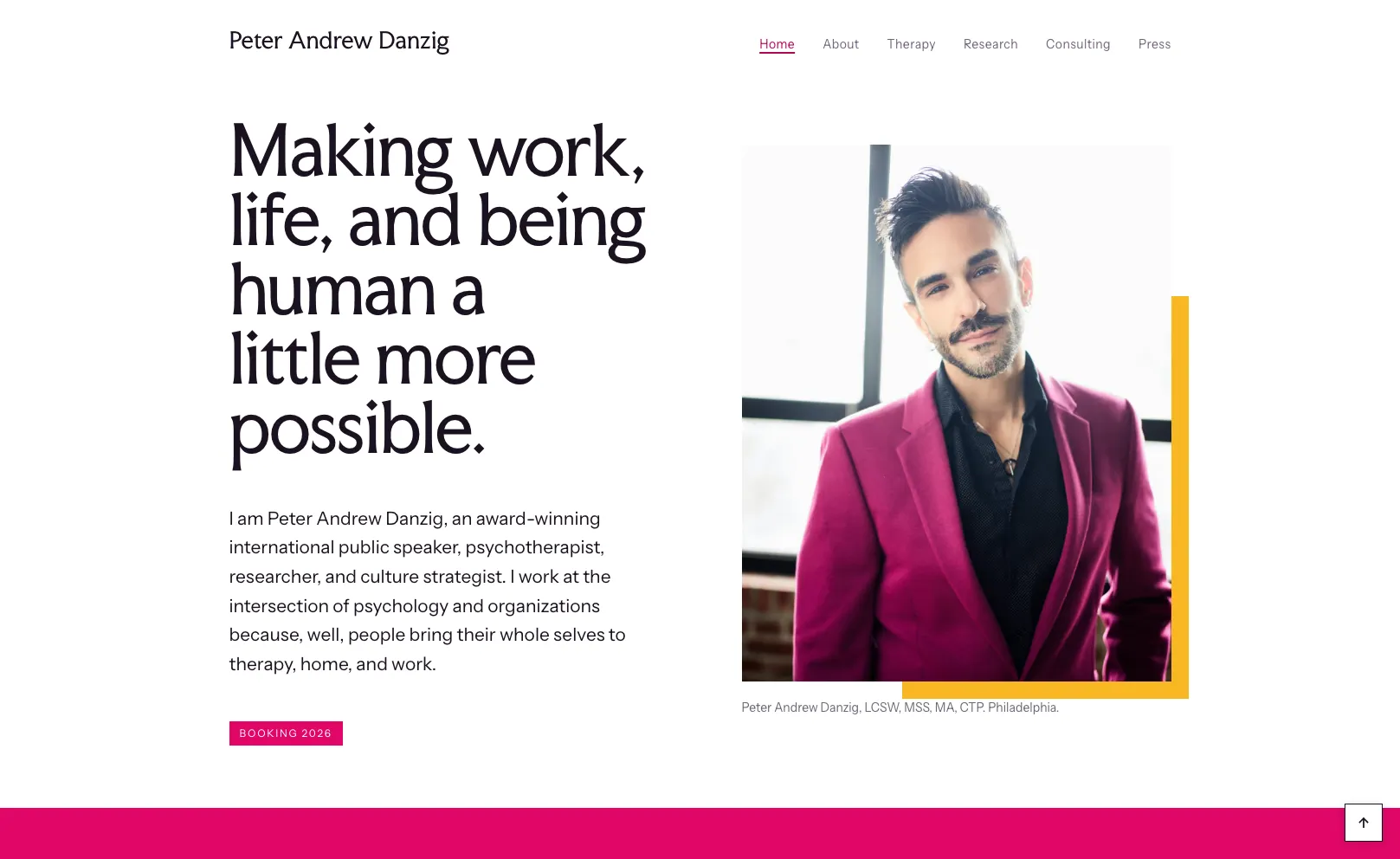
Results at a Glance
Google PageSpeed Insights
Core Web Vitals
On desktop, the page is painted in 0.4s, with Speed Index at 0.5s. On mobile, throttled to a slow 4G connection, Largest Contentful Paint is 2.0s, inside the 2.5-second line Google treats as good. Total Blocking Time is 0 ms and Cumulative Layout Shift is 0 on both.
The one amber number
Mobile Performance is 97, not 100. The one metric in amber is Speed Index on the throttled phone test, at 3.9 seconds. Speed Index measures how quickly the visible page fills in. Every other metric is green, and anyone can run the same report on PageSpeed Insights.
Project Overview
Peter Andrew Danzig, LCSW, works at the intersection of psychology and organizations. Their research covers play, creativity and belonging, and their work runs on three tracks at once: psychotherapy, research, and speaking and consulting for organizations.
The old site was on Weebly. I replaced it with a static Astro site on Cloudflare Pages, hosted on Peter's own Cloudflare account. The build started on August 18, 2026, and the site went live on August 28. Since launch I have kept working with Peter on refinements, including a redesign of the homepage's three practice cards.
Site Structure
Six pages, plus a real 404 page:
Two Audiences, One Front Door
The hardest part of this site was not a feature. It was serving two groups of people who want almost opposite things from the same homepage.
People Looking for a Therapist
They need the page to feel calm and safe, and to show Peter is qualified. The Therapy page is quieter than the rest of the site, with a warm, relaxed photograph chosen for it.
Organizations Booking a Speaker
Conference organizers and HR and learning leaders need polish, proof and a fast way to start a conversation. The Consulting page leads with stage photography, real footage and the organizations Peter has worked with.
The homepage splits the two early, without reading like a menu or two sites bolted together. After launch I mocked up three alternatives for that section and showed Peter all of them next to the original, at desktop and phone widths, before anything changed. Peter chose framed cards, one per practice, and that is what is live now.
A Therapy Path That Never Touches the Website
A therapy inquiry is a health inquiry, and the safest way to handle one on a marketing website is not to receive it at all. So the two paths end in different places on purpose.
A Palette Taken From Peter's Own Photographs
Peter's photography is full of color. Instead of choosing brand colors by taste, I sampled them from what Peter is wearing in their own photos. If anyone asks whether the site looks like Peter, the answer is literal.
Video That Costs Nothing Until It Is Watched
Peter had speaking footage and a recorded welcome video. Both made the site, and neither slows it down.
A Nine-Second Stage Clip
From the conference footage I cut one nine-second clip of Peter on stage, silent and cropped to sit with the stage photography on the Consulting page. It is 786 KB, served from the site itself, and only starts when it scrolls into view. A visitor who never scrolls that far downloads a 34 KB poster image and nothing else, and anyone who has asked their device for reduced motion never sees it move.
A Three-Minute Welcome, Captioned
On the About page, Peter introduces their work to camera. The file is too large for the site's host, so it is served from storage on Peter's own Cloudflare account. Nothing loads until the visitor presses play. It ships with English captions and a full transcript, which organizations that ask about accessibility will look for.
Inquiries That Reach Peter's Inbox
A speaking inquiry is the most valuable thing this site can produce, so the form behind it has to work every time:
Retiring the Old Site Cleanly
Every address the old Weebly site used, including old pages still listed in its sitemap, now sends a permanent 301 redirect to its real equivalent on the new site. That is seven redirects, each one checked in production, with no redirect chains. The www address redirects to the bare domain at Cloudflare's edge, so the site has exactly one canonical address.
At launch I also went through the domain's DNS. A wildcard record left over from the previous host was still serving the old site on any subdomain, along with three other records pointing at it. I removed all four, so the only version of Peter's site anyone can reach is the current one.
SEO Strategy
Peter is a person, not a storefront, so the structured data describes a person first and the practice second.
Person Schema With Credentials
The home page carries Person JSON-LD with Peter’s credentials, their Pennsylvania clinical social work license, and the three universities they studied at.
ProfessionalService Linked to the Person
A ProfessionalService node covers the practice, its service area and its topics, and points back to Peter as the provider.
Profiles Tied Together
sameAs links connect the site to Peter’s LinkedIn, Instagram, Facebook and Psychology Today profiles, so search engines can connect them to one person.
Clean Metadata
Every page has its own title and description, written from what is actually on that page, and exactly one H1.
Alt Text From the Photographs
Every image description was written from what is in the frame, by looking at it.
Sitemap and a Real 404
An XML sitemap lists all six pages, and unknown addresses return a true 404 rather than a page that pretends to exist.
Mobile and Accessibility
Accessibility scores 100 on mobile and desktop, and for a site that serves people seeking therapy, the details matter:
AI Discoverability
When someone asks an AI assistant for a speaker on psychological safety or play at work, the answer should be able to find Peter:
Technology Stack
| Component | Technology |
|---|---|
| Framework | Astro, static output |
| Styling | Tailwind CSS 4, with the palette, type scale and spacing as named tokens |
| Hosting | Cloudflare Pages on the client’s own account (global CDN, automatic HTTPS) |
| Domain / DNS | Cloudflare DNS (client-owned) |
| Video | Stage clip self-hosted; welcome video on Cloudflare R2 with WebVTT captions |
| Images | AVIF with WebP fallback, generated at build by sharp |
| Contact Form | Cloudflare Pages Function + Resend |
| Spam Protection | Cloudflare Turnstile (verified server-side) + honeypot + timing check |
| Google Workspace, with SPF, DKIM and DMARC | |
| SEO | JSON-LD (Person, ProfessionalService), XML sitemap, per-page canonical URLs |
| Therapy Intake | External, through Psychology Today. No clinical data on the site |
Hosting, DNS and the domain sit in Peter's own Cloudflare account, and the code in a private GitHub repository under Peter's name.
Kevin’s been incredible to work with on my site.
He was inclusive, caring, patient, and the most open to feedback designer I've worked with. His work and integrity are like no other. He very much understood the nuance of my audiences and work, and reflected on the minutia of details to ensure that the final product is exactly what I needed, with continued ongoing support and care!